Canada is Banning AI for Kids - But Should We Be Teaching It Instead?

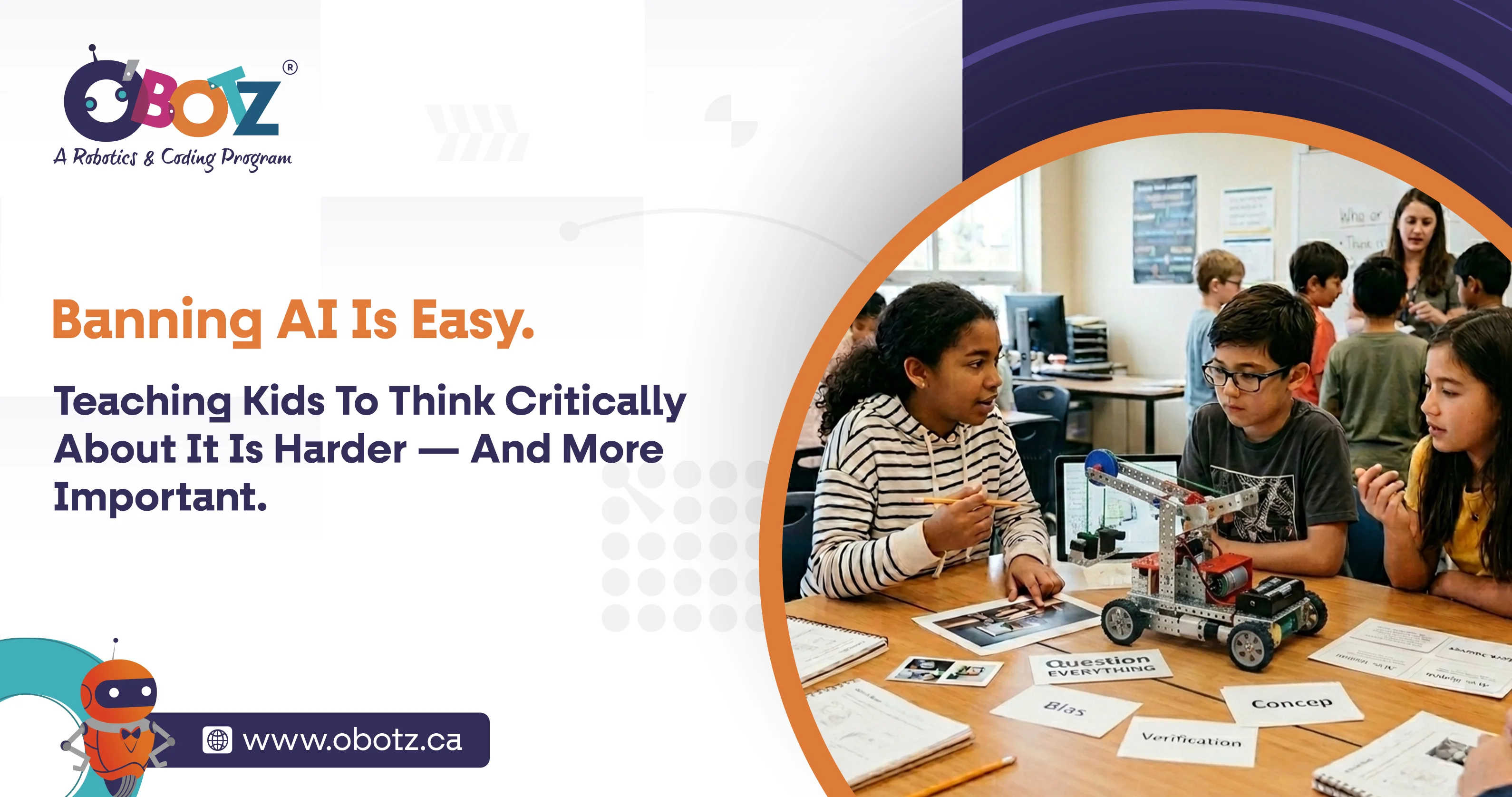
Artificial intelligence has become one of the most debated topics in education today. Across Canada, governments, educators, and parents are wrestling with an important question: How should children interact with AI?
Recent proposals in Canada seek to introduce stronger safeguards around children's access to social media and AI chatbots. The federal government recently introduced legislation aimed at making social media platforms and AI chatbots safer for children, reflecting growing concerns about online safety, misinformation, and mental health.
At the same time, AI adoption among students is accelerating. Research shows that AI use in education has become widespread, with a significant majority of students now using AI-powered tools in some form during their learning journey.

This creates an important dilemma.
If AI is becoming part of everyday life, should children simply be protected from it? Or should they be taught how it works, when to trust it, and how to use it responsibly?
At OBotz, we believe the answer lies in education, not avoidance.
The concerns are understandable.
AI tools can generate misleading information, encourage overreliance on technology, and expose children to inappropriate content when safeguards are weak. Recent discussions across Canada have highlighted concerns about children's mental health, online safety, and the potential misuse of AI-powered platforms.
Parents also worry about:
These are valid concerns.
However, history shows that banning a technology rarely eliminates its influence. Instead, it often creates a knowledge gap between those who understand the technology and those who do not.
Think about the internet.
The solution was never to prevent children from using it forever. Instead, schools introduced digital literacy programs to help students navigate online information safely.
The same principle applies today.
The future workforce will not simply use AI tools. They will collaborate with them, evaluate them, and build systems around them.
This is why AI literacy for children is becoming increasingly important.
AI literacy means teaching children:
Organizations such as UNESCO continue to advocate for responsible AI integration in education while emphasizing critical thinking, ethics, and human-centered learning.
Rather than fearing AI, children should learn how to question it.
When people hear "AI education," they often imagine children talking to chatbots.
But effective AI learning for children goes far beyond that.
Modern AI education introduces concepts such as:
1. Pattern Recognition: Children learn how machines identify patterns in data and make predictions.
2. Problem Solving: Students explore how technology can be used to solve real-world challenges.
3. Logical Thinking: AI concepts strengthen structured thinking and analytical reasoning.
4. Ethics and Responsibility: Children discuss fairness, privacy, bias, and the social impact of technology.
These are valuable life skills that extend well beyond AI itself.
Canada continues to invest heavily in innovation-driven industries.
As a result, STEM education Canada initiatives are becoming increasingly important for preparing students for future careers.

AI sits at the intersection of several STEM disciplines:
When children engage in robotics projects, coding activities, and engineering challenges, they naturally begin developing the foundational skills needed to understand AI.
This is why many educators view AI education not as a standalone subject but as part of a broader STEM learning journey.
Parents exploring STEM programs for kids Canada are increasingly looking for programs that combine technology with creativity, teamwork, and problem-solving.
Before children learn advanced AI concepts, they need to understand how technology follows instructions.
This is where coding classes for kids become valuable.
Coding teaches children:
These skills create a strong foundation for future AI learning.
Similarly, robotics classes for kids provide hands-on experiences that make technology tangible.
Instead of simply consuming technology, children begin creating it.
They learn:
This hands-on learning builds confidence and curiosity while helping children understand how intelligent systems operate.
If you enjoyed our discussion on technology education, you may also like our article on AI Chatbot Ban in Manitoba and what it will mean for Canadian families.
Many children already interact with AI every day without realizing it.
They encounter AI through:
The question is no longer whether children will encounter AI.
The question is whether they will understand it.
Experts increasingly argue that future success will depend not only on technical skills but also on the ability to evaluate AI-generated information critically and responsibly.
Children who develop AI literacy today may be better prepared to navigate tomorrow's workplaces, universities, and digital environments.
Parents don't need to turn their children into AI engineers overnight.
Instead, they can focus on building foundational skills:
1. Encourage Curiosity: Ask children how technology works rather than simply how to use it.
2. Introduce Coding Early: Begin with age-appropriate programming activities and projects.
3. Explore Robotics Programs: Hands-on learning helps children understand technology in a meaningful way.
4. Discuss Online Information: Teach children to verify facts rather than accepting every answer generated by a machine.
5. Focus on Critical Thinking: The most important future skill may not be coding itself, but the ability to think independently.
The debate surrounding AI and children is likely to continue for years.
Governments will create regulations. Schools will update curricula. Technology will evolve.
But one reality remains clear: Children growing up today will live in a world where AI is everywhere.
Trying to shield them completely from AI may not be realistic.
Teaching them to understand, question, and use AI responsibly may be the more effective long-term solution.
The goal should not be unrestricted access. The goal should be informed, responsible participation.
At OBotz Canada, we help children develop future-ready skills through engaging robotics, coding, and STEM-based learning experiences that encourage creativity, critical thinking, and innovation.
Book an OBotz Experience Today and open a practical pathway to learning for your kid.
Yes. Children do not need advanced technical knowledge, but understanding how AI works can help them become informed and responsible digital citizens. AI education can also strengthen critical thinking and problem-solving skills.
AI education helps children understand emerging technologies, develop logical thinking, and improve digital literacy. It also prepares them for future careers that will increasingly involve AI-powered tools.
AI can be safe when used with appropriate supervision, safeguards, and age-appropriate learning environments. Teaching children responsible AI usage is often more effective than simply restricting access.
AI naturally integrates concepts from science, technology, engineering, and mathematics. Learning AI can strengthen analytical thinking, coding skills, creativity, and problem-solving abilities.
Children can begin learning basic AI concepts as early as elementary school through games, coding activities, and robotics projects. The focus should be on understanding ideas rather than mastering complex technical details.