Can Robotics Classes Really Improve Creativity? OBotz Explains

Most parents hear the word robotics and instantly imagine coding, wires, electronics, and technical skills.
Creativity rarely comes to mind.
But here's the reality.
Some of the world's most creative innovators—from engineers and designers to entrepreneurs and game developers—share one common habit: they love building things.
That's exactly what robotics encourages.
Instead of simply following instructions, children imagine, experiment, fail, redesign, and create solutions that have never existed before. This combination of imagination and logical thinking is why educators worldwide increasingly recommend robotics classes for kids as one of the best ways to nurture future-ready minds.
At OBotz, creativity isn't treated as a separate skill—it's woven into every robotics challenge, coding project, and hands-on activity.
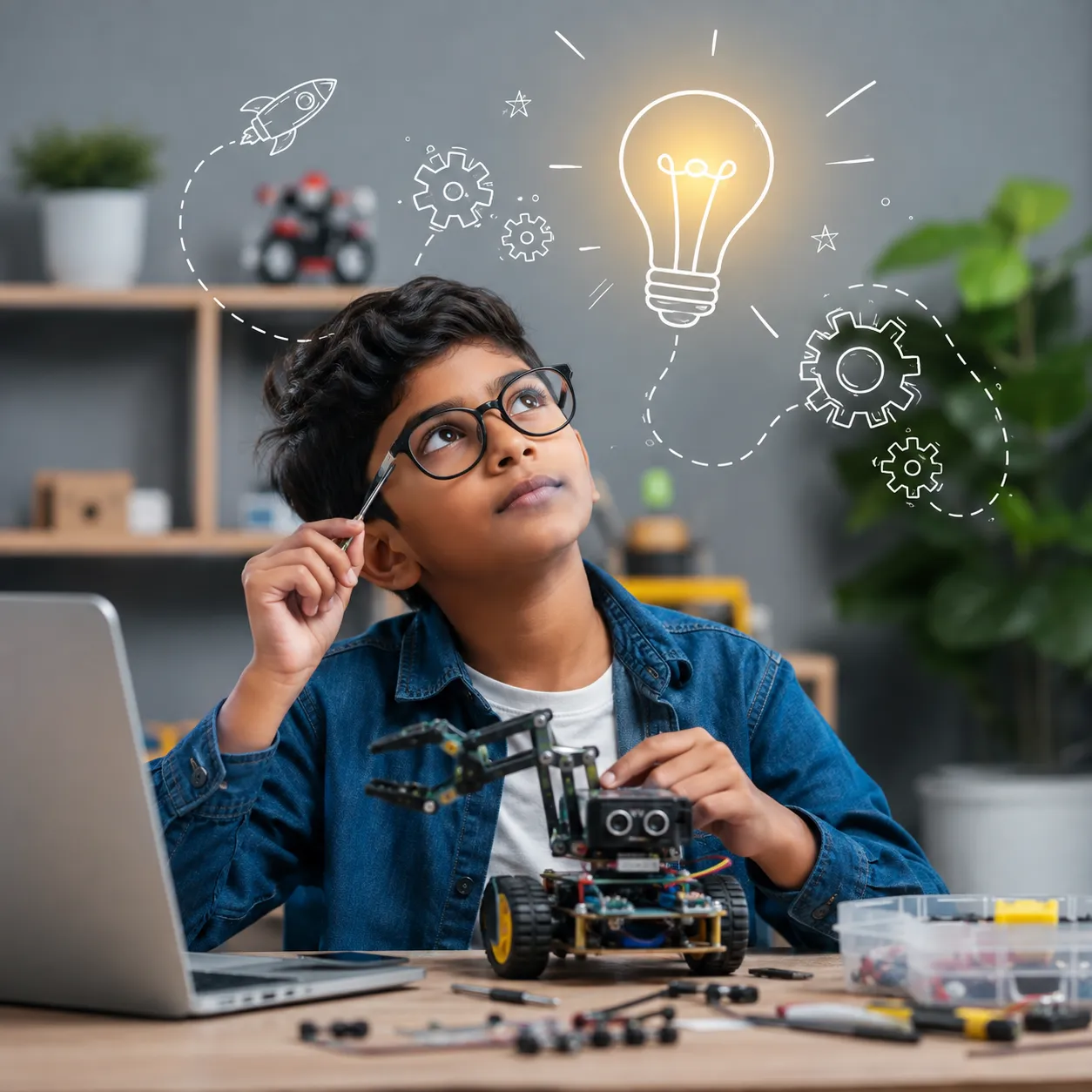
When people hear "creative child," they often picture someone sketching, painting, or playing music.
While artistic expression is certainly creative, modern creativity goes much further.
Today's children need to:
This type of creativity combines imagination with practical thinking.
Robotics naturally develops both.
Every project asks children a simple question:
"Can you build something that solves this problem?"
That question alone opens unlimited possibilities.
Unlike traditional classroom learning, robotics rarely has only one correct answer.
Two students may receive the exact same challenge.
For example:
Build a robot that can transport an object across the room.
One child may design wheels.
Another may create legs.
Someone else may invent a conveyor mechanism.
Each solution is different.
Each is creative.
This open-ended approach encourages children to experiment without worrying about finding the "perfect" answer.
Children have incredible imaginations.
The challenge is giving them opportunities to transform ideas into something tangible.
Robotics does exactly that.
Instead of imagining a machine, children actually build one.
Instead of talking about solutions, they test them.
Instead of fearing mistakes, they learn from them.
This "create-test-improve" cycle develops confidence alongside creativity.
Many of the hands-on activities in our robotics camps encourage children to iterate repeatedly until their designs perform better.
Every robot begins with a question.
Questions fuel creativity.
That's why curiosity is such an important part of robotics education.
Parents looking to nurture this mindset can also explore Proven Tips to Instill Curiosity in Teenagers, which shares practical ways to encourage exploration long before children start building advanced robots.
Many parents assume robotics only benefits children interested in engineering.
In reality, robotics is wonderfully multidisciplinary.
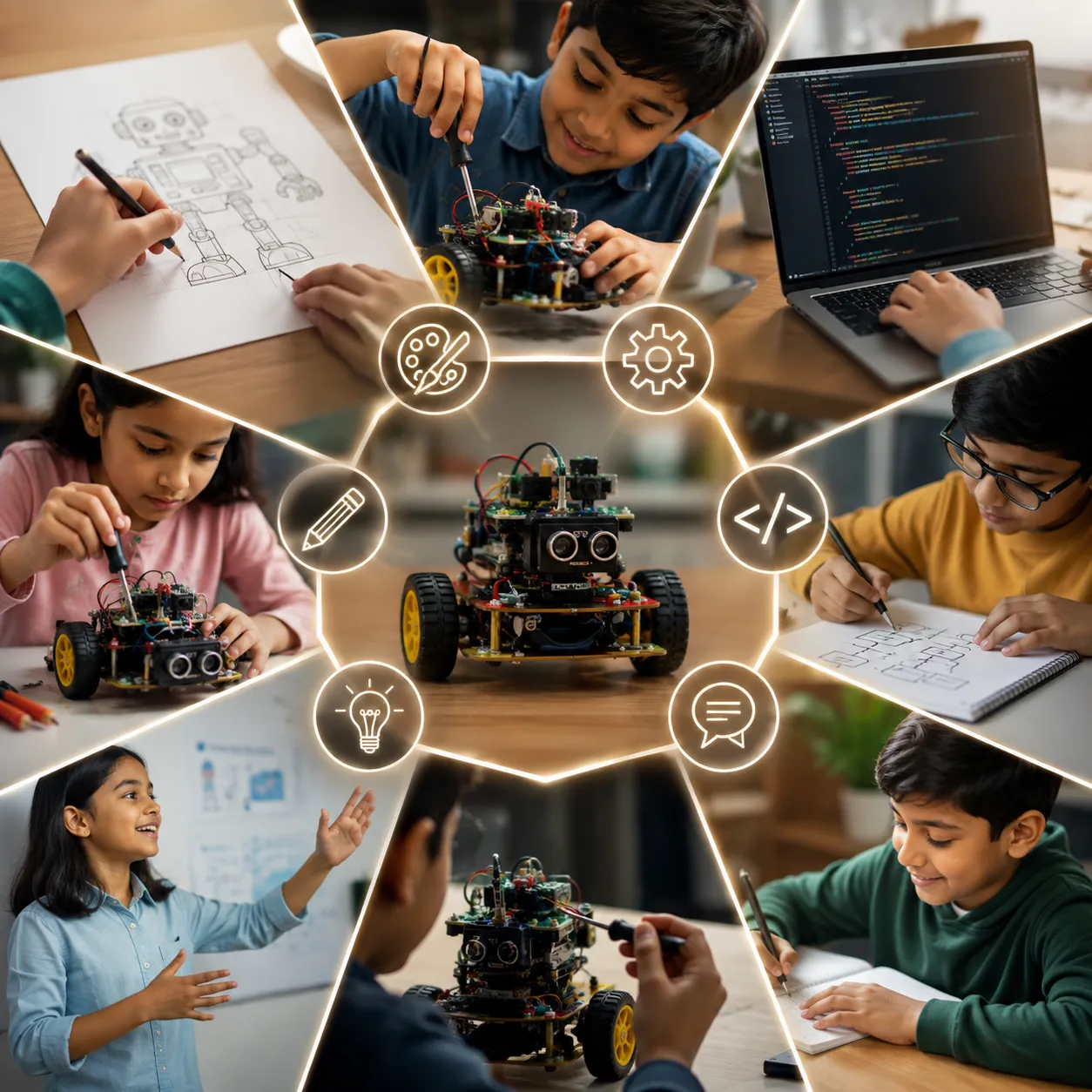
A single project may involve:
Children quickly discover that creativity and technology work best together.
Even online robotics classes for kids now include collaborative design activities that encourage students to think beyond programming.
The future doesn't simply reward knowledge.
It rewards problem-solvers.
Every robotics project introduces obstacles.
Maybe the robot won't move.
Maybe the sensor doesn't detect objects.
Maybe the code behaves unexpectedly.
Instead of giving up, children learn to:
This mindset becomes valuable far beyond robotics.
It helps children approach school projects, science experiments, entrepreneurship, and everyday challenges with confidence.
One of the biggest lessons robotics teaches is resourcefulness.
Children often create remarkable inventions using simple materials alongside robotics components.
For inspiration, explore How Kids Can Turn Recycled Materials into Robots, where everyday objects become imaginative engineering projects.
This teaches children that creativity depends more on ideas than expensive tools.
Some of the smartest robots ever designed take inspiration from nature.
Engineers study birds, insects, fish, and animals to develop innovative robotic systems.
Children love discovering how technology learns from the natural world.
The blog Exploring Biomimicry: Where Robotics Meets Nature introduces young learners to this fascinating connection, encouraging them to observe nature with a designer's mindset.
School schedules often leave little time for experimentation.
A dedicated robotics summer camp gives children the freedom to build, invent, collaborate, and explore without academic pressure.
Extended project time allows them to:
Parents searching for engaging vacation learning experiences can explore the OBotz Summer Camp, where innovation, teamwork, and creativity come together through exciting robotics challenges.
Many families also discover coding camps for kids complement robotics by helping children bring even more sophisticated ideas to life.
At OBotz, robotics isn't about memorizing code.
It's about empowering children to believe:
"I can create something meaningful."
Every project is designed to strengthen both analytical and creative thinking.
Children learn to:
These experiences build creative confidence that benefits children in academics, future careers, and everyday life.
Whether children dream of becoming engineers, designers, entrepreneurs, architects, scientists, or artists, creative thinking will always remain one of their greatest strengths.
Technology alone doesn't create innovators.
Creative minds do.
Robotics provides children with the rare opportunity to combine imagination, engineering, coding, design, collaboration, and problem-solving into one engaging learning experience.
That's why robotics is no longer viewed simply as technical education—it's becoming one of the most effective ways to develop future-ready thinkers.
Explore the innovative learning experiences offered by OBotz and discover how your child can unlock creativity through hands-on robotics learning.
Book an OBotz experience today and let your child discover the joy of inventing, building, and creating through robotics.
Robotics develops much more than technical skills. Children brainstorm ideas, design solutions, experiment with different approaches, and improve their creations, making creativity a natural part of the learning process.
Building robots encourages children to imagine solutions before creating them. Programming adds another layer of creativity by allowing them to experiment, test ideas, and continuously refine their designs.
Hands-on projects require children to solve real challenges rather than memorize answers. They learn to analyze problems, think independently, test different ideas, and develop innovative solutions through experience.
Absolutely. Robotics combines storytelling, design, engineering, creativity, and teamwork, making it appealing even for children whose strengths lie in art, imagination, or creative expression rather than mathematics alone.
OBotz combines logical thinking, coding, and engineering with creativity, design, collaboration, and innovation. This balanced approach helps children develop analytical reasoning alongside imagination and creative confidence.
Yes. High-quality robotics programs encourage children to build, present, experiment, and solve challenges independently. These experiences improve creative confidence, communication, resilience, and problem-solving in addition to coding skills.