How Do Smart Robots Make Decisions? A Kid-Friendly Explanation

Imagine your child watching a tiny robot zoom across the living room. Suddenly, it approaches a wall, stops and turns in another direction.
Your child wonders, "How did it know there was a wall? Did it actually think?"
That's where the fascinating world of robotics begins!
Understanding how robots make decisions is easier than it sounds. Robots don't need human brains to perform impressive tasks. They use sensors, instructions and computer programs to respond to their surroundings.
At OBotz, children explore these concepts through hands-on robotics activities that turn curious questions into exciting discoveries.
Let's uncover what happens inside a smart robot!
Here's a surprising fact: Most robots don't actually think the way humans do!
When you see a robot moving independently, it's usually following instructions written by a programmer.
Consider a robot vacuum cleaner.
This is a simple robotics explanation for children: a robot collects information, processes it using programmed rules and performs an action.
When children ask, "how do robots think?", we can explain that robots process information rather than experience thoughts like humans.
Some advanced robots use artificial intelligence in robots to recognize patterns, interpret information or select actions. However, even these systems operate through computational processes, not human-like understanding.
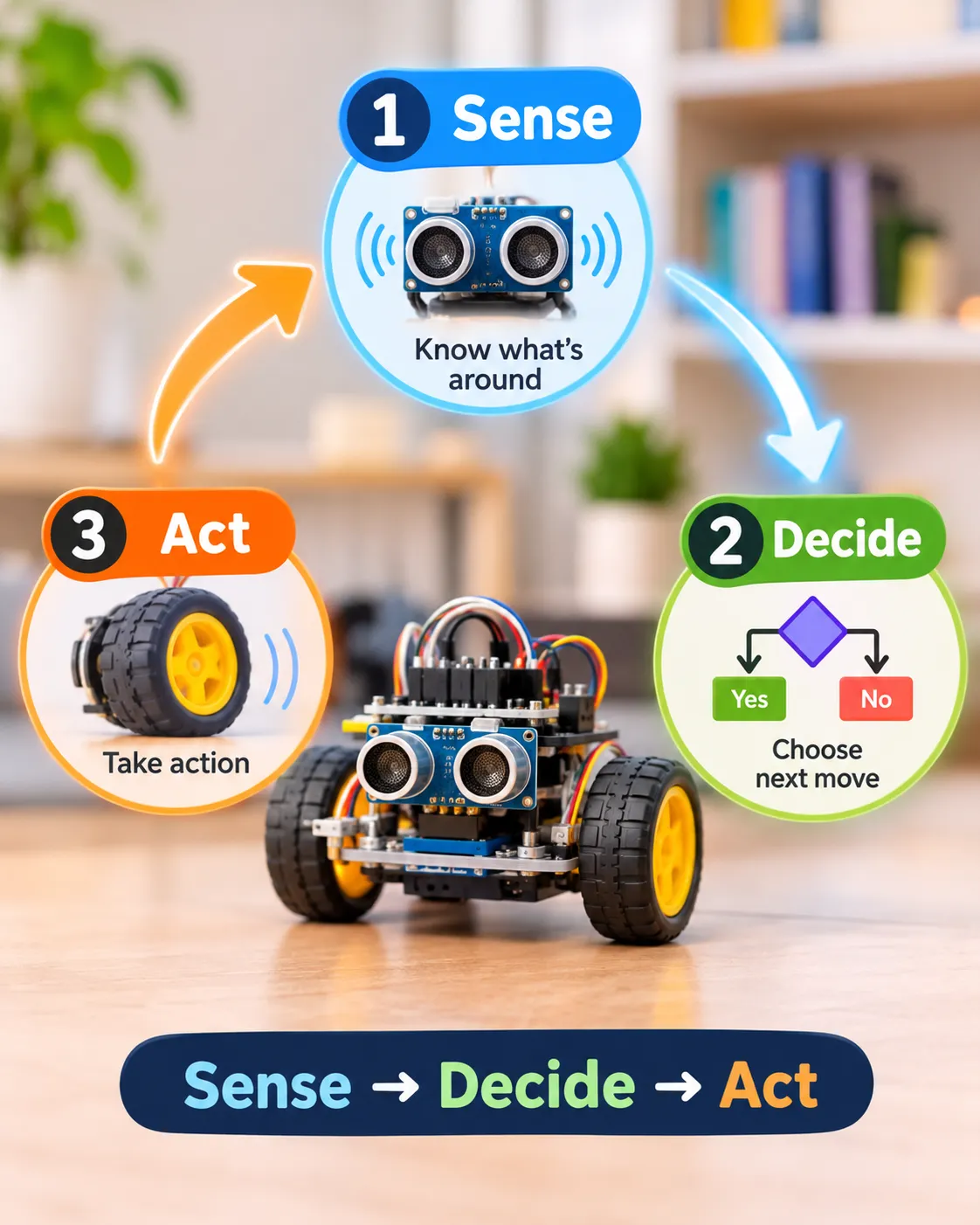
Most robot decisions can be understood through three connected steps.
Imagine walking into a dark room. You might stretch your hands forward to avoid bumping into furniture.
Robots use sensors for a similar purpose!
Sensors and inputs allow robots to collect information about their environment.
|
Sensor |
What It Detects |
|
Distance sensor |
Nearby objects and obstacles |
|
Light sensor |
Changes in brightness |
|
Touch sensor |
Physical contact |
|
Sound sensor |
Sounds or noise levels |
|
Colour sensor |
Colours on a surface |
If you're wondering how to explain sensors to kids, try this comparison: sensors are like a robot's information collectors.
They don't necessarily understand what they're detecting. They simply send information to the robot's controller.
Once the robot receives information, it follows programmed instructions.
One of the simplest concepts in robotics for kids is if-then logic.
For example:
IF an obstacle is closer than 10 centimetres, THEN stop and turn.
IF the path is clear, THEN continue moving forward.
IF the light becomes brighter, THEN switch off the robot's LED.
These rules demonstrate cause and effect coding, where specific conditions trigger specific responses.
Children can experiment by changing the instructions and observing how the robot behaves differently.
After processing the information, the robot activates its components.
Depending on its design, it might:
This creates a repeating cycle:
Sense → Decide → Act → Sense Again
The robot continuously checks its surroundings and responds according to its programming.
Let's imagine your child building an obstacle-avoiding robot.
The challenge? Make it travel across a room without crashing into furniture.
Here's what happens:
But here's where things get interesting!
What if the robot keeps turning into another obstacle?
Your child must investigate the problem, modify the instructions and test the solution.
This introduces an essential concept behind algorithms for kids: an algorithm is a sequence of steps designed to complete a task.
And sometimes, improving that sequence takes several attempts!
Absolutely! Programming robots gives children opportunities to experiment with instructions and observe their results.
For example, children could challenge their robot to:
Each activity encourages children to predict outcomes, test ideas and identify errors.
For parents wondering how robots know what to do, the answer is often found in the code children create.
Through practical robotics projects and activities, children can explore how programming concepts connect with real robotic movements.
Here's something children might find surprising: A robot can follow its instructions perfectly and still make a mistake!
Imagine a robot programmed to stop when an object is less than 10 centimetres away.
But its sensor provides an inaccurate reading.
The robot might bump into the object even though the code is correct.
Other problems might include:
Finding and fixing these problems is called debugging.
Instead of simply receiving the correct answer, children learn to investigate what went wrong and try another solution.
This is one reason why coding, robotics and AI learning can provide meaningful opportunities to practise logical reasoning and problem-solving.
A child might initially see a robot as an entertaining toy.
But what happens when they discover they can control its actions?
They begin asking different questions.
"Can I make it move faster?"
"What if I add another sensor?"
"Can I make it recognize two different colours?"
These questions transform passive observation into experimentation.
As explored in how robots can become valuable learning companions, interacting with robots can open opportunities for creativity, curiosity and active participation.
Structured robotics classes for kids can help children explore these ideas through guided projects and progressively challenging activities.
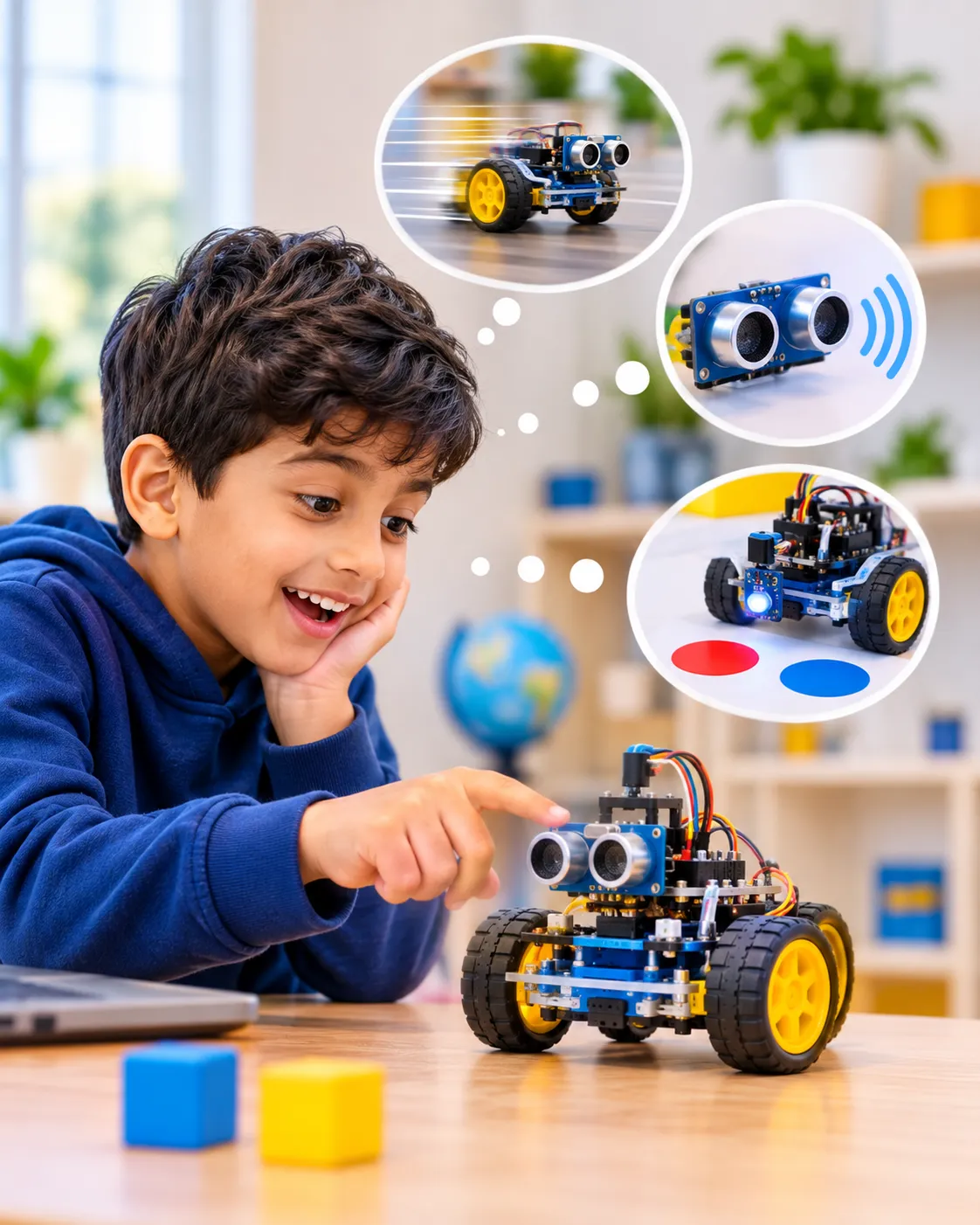
Smart robots might appear intelligent, but their actions are powered by sensors, programming and carefully designed instructions.
When children understand these principles, they discover something exciting: they don't have to simply watch robots work. They can learn to build and program them!
Through the OBotz Robotics Program, children can explore robotics concepts through practical activities, coding challenges and experimentation.
Discover how OBotz makes robotics learning engaging and accessible for young learners.
Give your child the opportunity to move beyond asking how robots work and start discovering how to create them.
Robots collect information through sensors, process it using programmed instructions or computational models, and perform actions based on the results.
Robots follow instructions created by programmers, using sensor information to determine which actions to perform in different situations.
Robots may use distance, light, touch, sound and colour sensors to detect objects, environmental changes and other useful information.
No. Robots process information using computer programs and sometimes AI, but they do not think or understand the world like humans.
An algorithm is a set of step-by-step instructions for completing a task, similar to following a recipe or directions.
Children can explore robotics classes for kids through OBotz, where guided projects introduce coding, robot construction and practical problem-solving.