Is Coding Still Worth Learning for Kids With AI Tools Like ChatGPT or Claude?

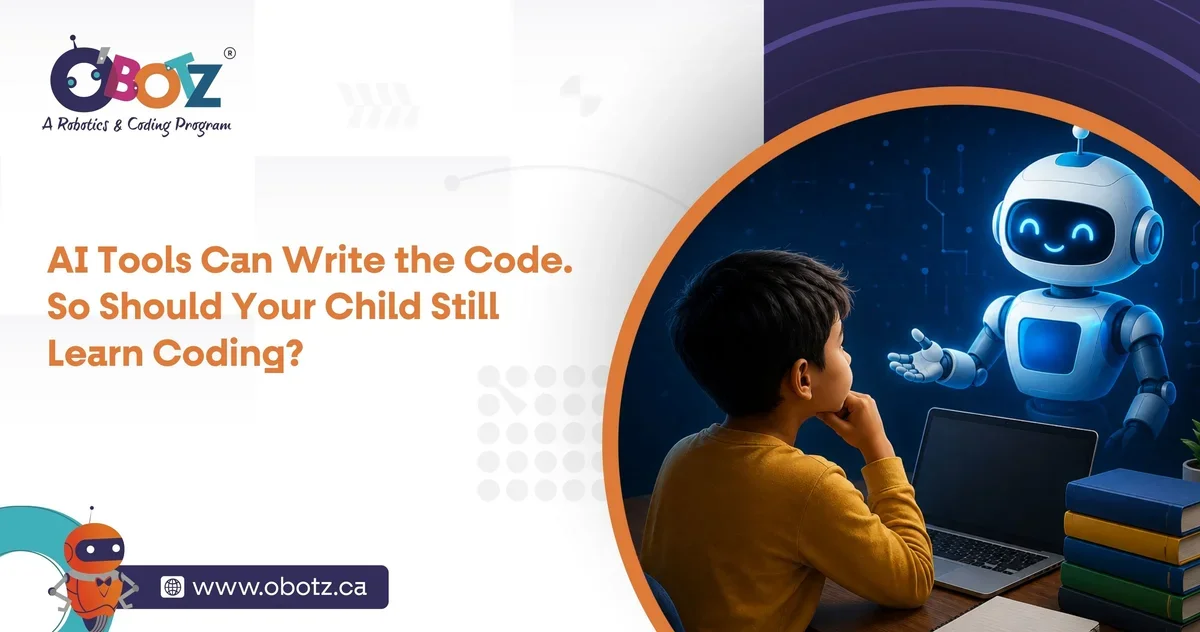
A child types a sentence into an AI tool. Seconds later, a working piece of code appears.
For parents watching tools such as ChatGPT and Claude become increasingly capable, an obvious question follows: Why should my child spend years learning to code if AI can simply write it for them?
It is a reasonable question—but it assumes that coding education is only about producing lines of code.
It isn't.
As AI changes how software is created, the value of coding is shifting from simply knowing syntax to understanding logic, systems, problem-solving and how to tell technology what to do. At OBotz, students experience technology through programming, robotics and increasingly advanced concepts rather than treating coding as an isolated skill.
So, is coding worth learning with AI? Yes—but what children learn from coding matters more than ever.
Ask an AI assistant to create a simple game, website or Python program, and it may generate usable code almost instantly.
That changes the role of the programmer. It doesn't necessarily eliminate it.
Someone still needs to decide:
A child who simply copies AI-generated code is dependent on the tool. A child who understands programming can question, test, debug and improve what AI produces.
That distinction is central to the debate around whether coding is worth it in the AI era.
The question, therefore, isn't simply will coding be replaced by AI? A better question is: Who will be better prepared to use AI—the child who understands what is happening behind the screen or the child who only knows which prompt to type?

Think about calculators.
Calculators made arithmetic dramatically faster, but children still learn mathematics because understanding numbers, relationships and mathematical reasoning has value beyond manually calculating an answer.
AI-generated code creates a similar situation.
Coding teaches children to break a large challenge into smaller steps, recognize patterns, build logical sequences, test hypotheses and learn from failure. OBotz's own coding curriculum includes concepts such as control loops, logic building, algorithm development and eventually Embedded C and Python for AI applications.
This is why coding relevance in AI age discussions should go beyond asking whether children will manually type every command in their future jobs.
The deeper value lies in the thinking behind those commands.
Parents wondering should kids learn to code in the AI era should consider coding as a way to develop computational thinking—not merely as preparation to become professional programmers.
That is also why coding still matters alongside robotics and emerging technologies. OBotz highlights problem-solving, creativity and digital literacy as important outcomes of coding and robotics education.
Parents may soon find themselves asking: Should my child learn coding if AI can write code?
But coding vs AI tools for kids creates a false choice.
Children should learn to code with AI, not abandon coding because of AI.
Imagine two students receiving an AI-generated program that doesn't work correctly.
One doesn't understand programming. They may repeatedly ask AI to fix it and hope the next answer works.
The other understands variables, conditions, loops and functions. They can examine the output, identify potential problems, test alternatives and give AI better instructions.
Which child is really in control of the technology?
Learning to code with AI assistance can help children move from passive AI consumption toward active experimentation. AI becomes a collaborator, tutor or productivity tool—not a substitute for thinking.
Parents can also explore what Canadian students should understand about AI as AI becomes a more familiar part of education and everyday technology.
The future of coding skills probably won't revolve around memorizing hundreds of commands.
AI is exceptionally useful at recalling syntax and producing boilerplate code. That makes higher-level abilities increasingly important.
Children benefit from learning how to:
These are closer to AI-proof skills for kids because they involve judgement, creativity and problem-solving.
OBotz's coding program for kids progresses from visual programming toward Embedded C and advanced applications, while its ML-AI curriculum introduces concepts such as algorithms, data, machine-learning processes and Python.
The goal isn't to make children compete with AI at generating code.
It is to help them understand enough to build with AI intelligently.
For many children, AI can appear almost magical: ask a question and an answer appears.
Coding helps remove some of that mystery.
When children understand inputs, outputs, algorithms, data and instructions, they begin asking better questions about technology. Why did the system produce that result? What information did it use? Could the output be wrong? How could we test it?
Those questions become increasingly important as children develop skills for an AI-driven world.
Instead of seeing AI as an all-knowing machine, children can begin understanding it as technology designed, trained and directed by humans.
OBotz's ML and AI learning program combines programming with concepts including data, algorithms, training processes and testing. Its program also introduces Python for AI and ML applications.
That combination matters because AI literacy without technological understanding can easily become AI dependency.
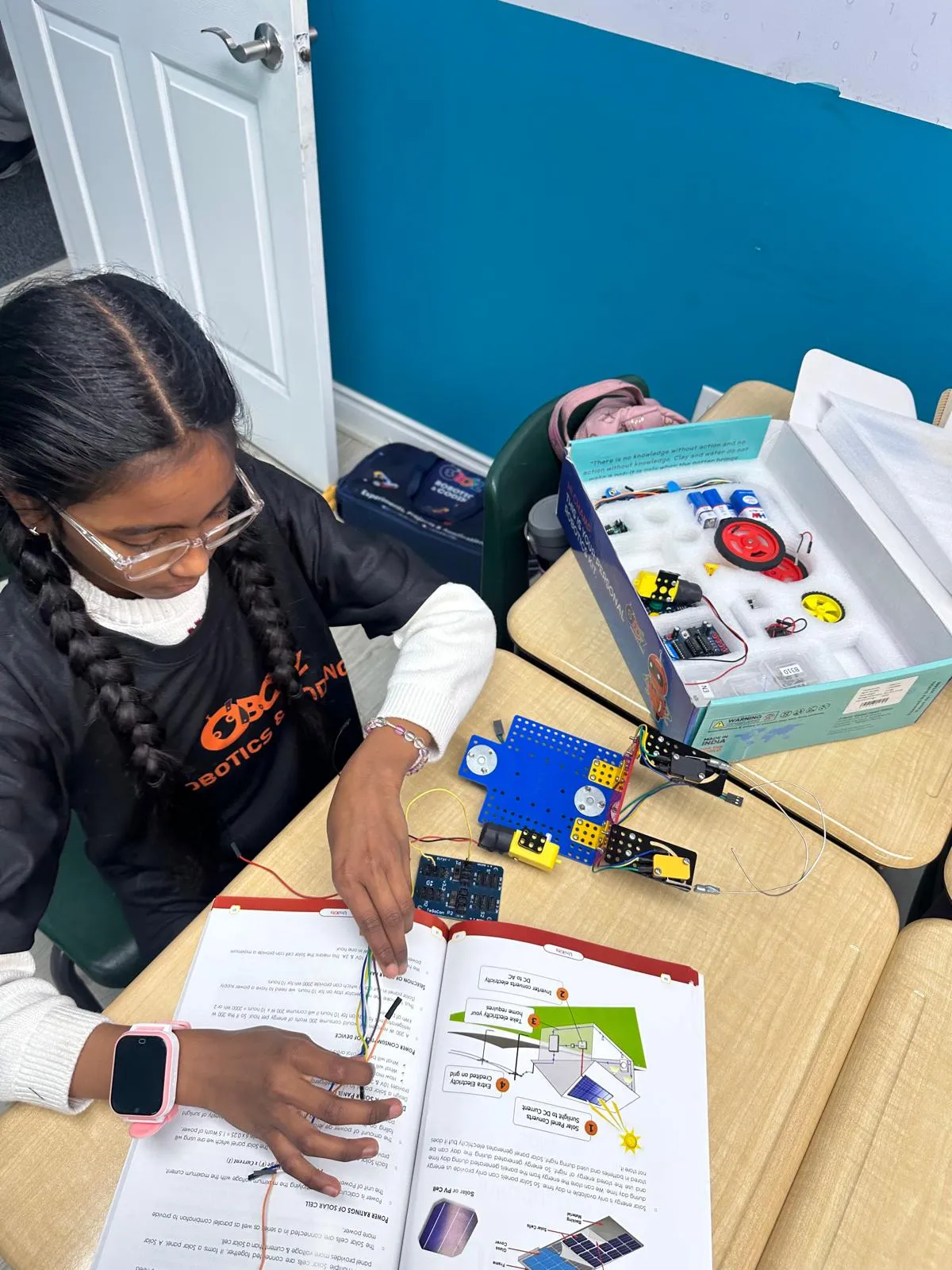
Perhaps the biggest change AI brings isn't the death of coding. It is the evolution of what it means to be good at it.
Tomorrow's students may spend less time writing every line manually and more time designing systems, directing AI, checking generated code and integrating software into larger projects.
That is why Gen Alpha's relationship with AI and robotics deserves attention.
The children who thrive may not necessarily be the fastest typists or the ones who memorize the most programming syntax. They may be the ones who can imagine something useful, understand how technology works well enough to build it, and use AI to accelerate the process.
In that future, why coding still matters becomes clearer: coding gives children a language for understanding and creating technology rather than merely consuming it.
So, is coding still worth it with AI tools?
Absolutely—but coding education needs to evolve with the technology around it.
Children shouldn't spend all their time memorizing syntax that an AI assistant can retrieve instantly. They should learn programming through experimentation, robotics, problem-solving and real projects that require them to think.
The strongest approach isn't coding or AI.
It is coding + AI + creativity + problem-solving.
At OBotz, children can progress through hands-on robotics and coding into areas such as Embedded C, Python, ML-AI, drones and AR/VR, connecting programming with real technological applications.
AI may write tomorrow's code.
But children still need to decide what tomorrow is worth building.
Ready to help your child move from simply using technology to understanding and creating it? Book an OBotz experience and let them explore coding, robotics and emerging technology through hands-on learning.
Yes. AI can generate code, but coding teaches children computational thinking, debugging, logic and problem-solving—skills they need to understand and evaluate what AI creates.
AI will likely change how people code rather than eliminate the need to understand programming. Children who understand coding can give AI better instructions, evaluate its output and develop more sophisticated solutions.
Coding introduces children to algorithms, inputs, outputs, logic and data, making AI feel less like a mysterious answer machine and more like technology they can understand and question.
Problem decomposition, computational thinking, debugging, algorithmic reasoning, system design and the ability to evaluate AI-generated code are likely to remain valuable even as coding tools become more automated.
Ideally, children should develop both. Coding provides foundational technical understanding, while AI literacy teaches them how to use, question and interact responsibly with increasingly powerful AI systems.
Coding helps children understand how digital systems operate, while AI can help them experiment and build faster. Together, they can shift children from passive technology users toward confident creators.
Software engineering, AI and machine-learning development, robotics, cybersecurity, data science, automation, game development and many engineering roles are likely to continue benefiting from strong programming knowledge, even when professionals use AI coding assistants.