Drone Programming for Teens: More Than Just Flying

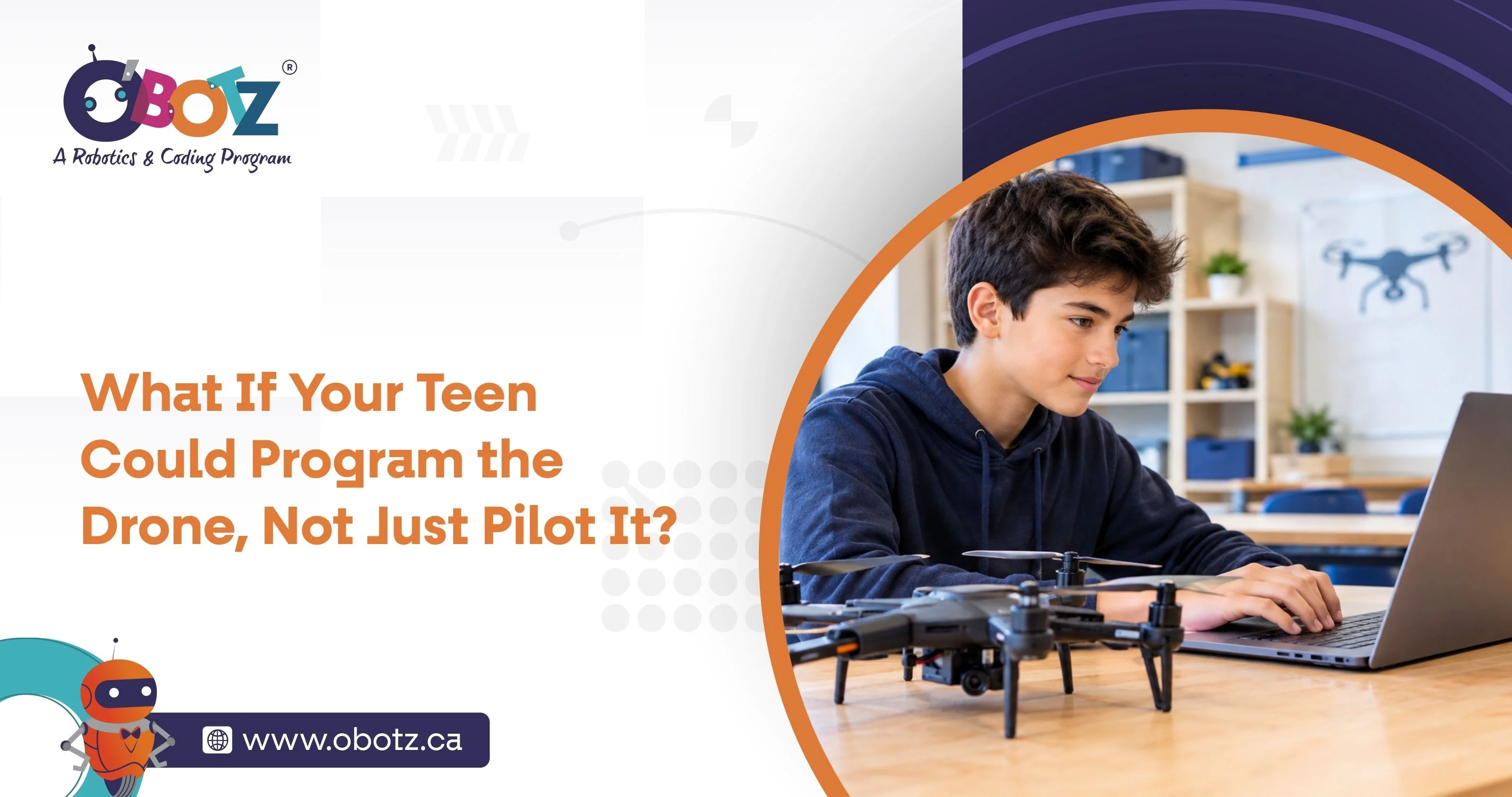
Hand a teenager a drone and chances are they will want to get it into the air immediately. Flying through an open space, controlling turns, adjusting height, and attempting the perfect landing is undeniably exciting.
But what if, instead of simply asking, “How high can this drone fly?” your teen started asking, “How can I program it to do that on its own?”
That question changes everything.
At OBotz, drones are not treated as just cool gadgets. They become hands-on learning tools that introduce students to coding, engineering, aerodynamics, electronics, problem-solving, and real-world technology. OBotz’s programs include drone learning among its advanced offerings, giving young learners an opportunity to explore technology by actually building and experimenting with it.
That is what makes drone programming for teens so interesting. The thrill of flight may get them through the door, but what they learn behind that flight can be far more valuable.
There is a big difference between controlling a drone and understanding what makes it work.
When teens fly a ready-made drone, they are primarily operating technology someone else has designed and programmed. When they start coding drones, they move from being users of technology to becoming creators.
Think about a simple command: make the drone take off, move forward, turn, and land.
A pilot can do this manually with a controller. A programmer has to think through the sequence logically. What instruction comes first? How far should the drone move? When should it turn? What happens if something goes wrong?
This drone flight vs drone coding distinction is where deeper learning begins.
Teens are no longer simply watching technology respond. They are learning how instructions, hardware, movement, and logic work together.
Parents searching for a drone programming course may assume it is mainly a coding class with a drone added to make things more exciting. In reality, drone learning can bring several STEM disciplines together in one project.
OBotz’s drone program introduces learners to building and simulating drones, pitch, roll and yaw, propeller configuration, coding, delivery, racing, and search-and-rescue applications.
Through this kind of hands-on learning, teens can explore:
Programming and logical thinking: A drone follows instructions precisely. Teens therefore have to break an objective into smaller steps, organize commands logically, test them, and improve the program when something does not work.
Engineering and construction: In a drone building workshop, students can go beyond operating a finished product and begin understanding its components and construction.
Aerodynamics: Why does a drone tilt forward to move? What are pitch, roll, and yaw? Why does propeller configuration matter? Suddenly, concepts from physics have a visible, flying application.
Troubleshooting: Code does not always work perfectly the first time, and neither does a physical build. Teens learn to identify what went wrong, test possible fixes, and try again.
This is what makes drone technology for students such an engaging STEM experience: the result of an idea is not trapped on a computer screen. Students can actually watch their thinking take flight.
One of the most exciting steps in learning drone technology is understanding autonomous drones.
Instead of controlling every movement manually, students can begin exploring how programmed instructions can determine what a drone does.
Imagine the difference between these two challenges:
“Fly the drone from Point A to Point B.”
And:
“Program the drone to travel from Point A to Point B using a planned sequence.”
The destination may be identical, but the thinking required is completely different.
The second challenge demands planning, sequencing, prediction, testing, and debugging. If the drone turns too early or travels too far, the student has to figure out why.
That process teaches an important lesson: failure is information.
Rather than immediately asking an instructor for the answer, teens learn to inspect their own logic and experiment with a solution. It is the kind of problem-solving mindset that extends well beyond programming quadcopters.
There is something uniquely valuable about understanding the machine before programming it.
A teen who only sees a completed drone may view it as one piece of technology. A student who assembles one starts seeing motors, propellers, electronics, structure, balance, and interconnected systems.
OBotz’s drone-making learning experiences introduce students to drone construction and operation, including assembly, aerodynamics, electronics, remote-control technology, and coding.
That is why a hands-on OBotz drone program can offer something very different from simply buying a drone and practising in the backyard.
The goal is not just, “Can you fly it?”
It becomes, “Do you understand what you built, why it flies, and how you can control its behaviour?”
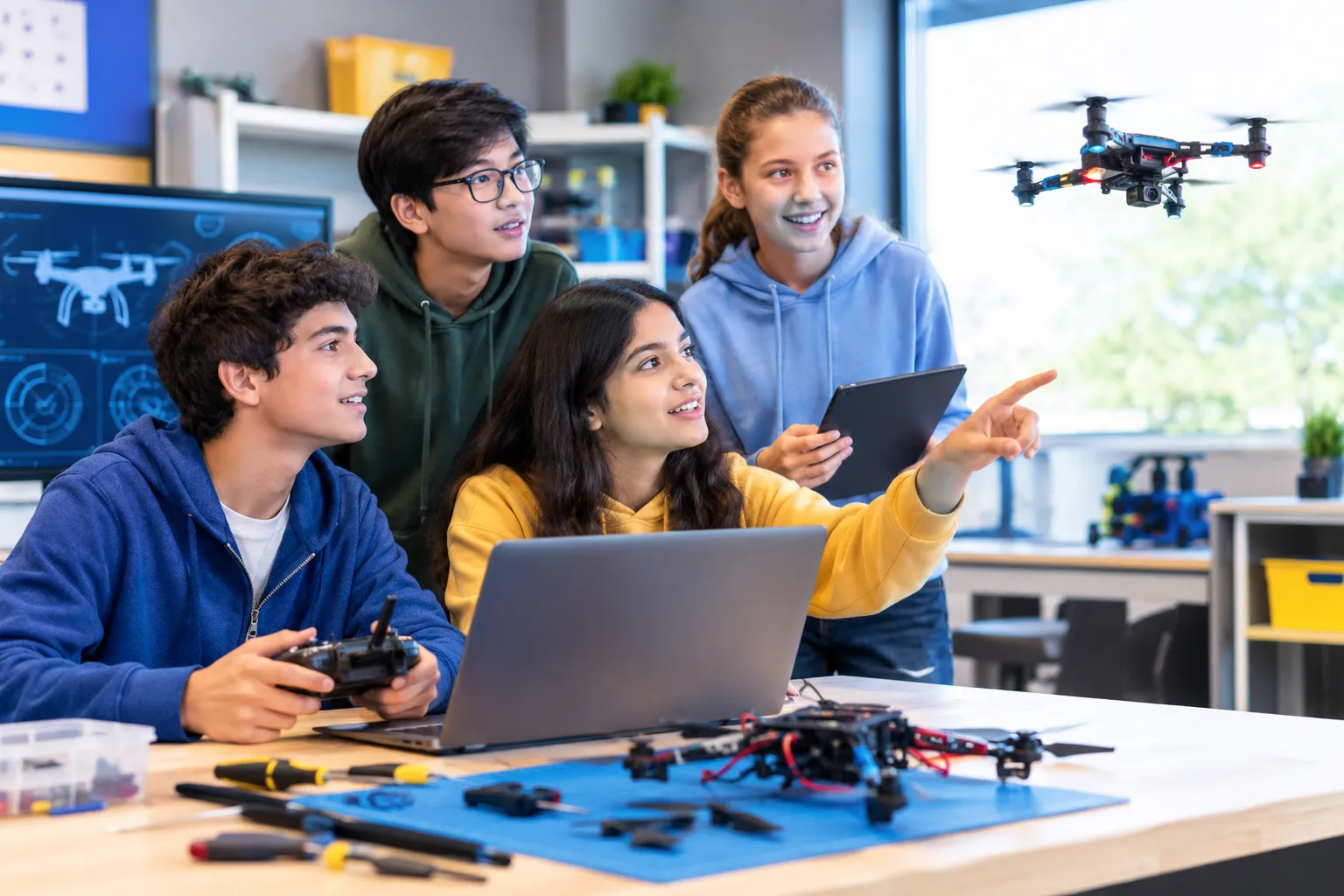
Not every teenager gets excited when they hear the words “coding exercise.”
Tell them they need to program a drone for a rescue mission, delivery challenge, or specific flight path, however, and the same coding concepts suddenly have a purpose.
That is why project-based STEM drones can be so effective at holding students’ attention.
For example, teens could be challenged to think about how drones might inspect difficult-to-reach locations, deliver an object, collect information, or support search-and-rescue operations.
Parents can explore more ideas about inspiring kids to build drones with purpose rather than treating drones purely as entertainment.
When students are given a problem instead of a list of instructions, they have room to experiment, make decisions, and create their own solutions.
A teenager does not need to decide on a career simply because they enjoy drones. But learning how emerging technology works can expose them to fields they may never have considered before.
Drone technology intersects with areas such as engineering, software development, robotics, mapping, surveying, agriculture, inspection, media, logistics, and public-safety applications.
More importantly, teens develop transferable abilities along the way: coding logic, troubleshooting, analytical thinking, engineering curiosity, and confidence with unfamiliar technology.
For parents wondering about the longer-term possibilities, OBotz also explores why learning about drones may support future career preparation.
The point is not to turn every learner into a drone engineer. It is to help teens become comfortable understanding, questioning, building, and programming the technologies around them.
If your teen already loves drones, technology, building things, or figuring out how gadgets work, drone classes for kids and teens can channel that curiosity into structured learning.
Even a teen who has never coded before may find the physical nature of drones more approachable than learning programming through abstract exercises alone.
They get to write an instruction and see what happens.
If it works, they can push the challenge further.
If it fails, they troubleshoot.
If they become curious about why it failed, real learning has already begun.
That is the real value when teens learn drone coding. They stop seeing technology as something that simply works when a button is pressed and start understanding the decisions, logic, engineering, and experimentation happening behind that button.
Flying a drone can be exciting for an afternoon. Understanding how to build and program one can open the door to a much bigger world of STEM.
Through hands-on technology education, OBotz helps young learners explore robotics, coding, engineering, and emerging technologies through practical projects.
So, the next time your teen watches a drone take off, encourage them to ask more than, “Can I fly it?”
Ask them, “Could you build it? Could you code it? Could you make it fly on its own?”
That is where the real challenge begins.
Give your teen the opportunity to explore what happens behind the controller. Book an OBotz experience and let them discover how building, coding, and experimentation can turn curiosity about drones into real STEM learning.
Yes. Teens can learn drone programming through age-appropriate, hands-on instruction that introduces coding, flight concepts, construction, and troubleshooting progressively.
Flying involves manually controlling the drone, while programming involves creating instructions that determine how the drone behaves or moves. Programming therefore requires more planning, coding logic, testing, and problem-solving.
They can be valuable for teens interested in technology because they combine programming with engineering, electronics, aerodynamics, and hands-on problem-solving rather than teaching coding only through screen-based exercises.
Drone-related knowledge can be relevant to fields including robotics, software development, engineering, surveying, mapping, agriculture, inspection, logistics, and other technology-focused industries.
Families looking for drone programs for kids in Canada or teen drone workshops Ontario can explore OBotz programs and locations. OBotz offers centres across several Canadian provinces, including numerous locations in Ontario.