The New IQ: Why Curiosity Beats Intelligence in Tech Learning

For decades, parents believed intelligence was the biggest predictor of success. High grades, strong IQ scores, and academic excellence were considered the ultimate indicators of a bright future.
Today, the technology industry tells a very different story.
The world's most successful innovators aren't necessarily the people who knew all the answers as children. They're the ones who kept asking better questions.
Curiosity has become one of the most valuable skills in the digital age. Whether children are learning programming, designing robots, or solving real-world engineering challenges, their willingness to explore often matters far more than how "smart" they appear on paper.
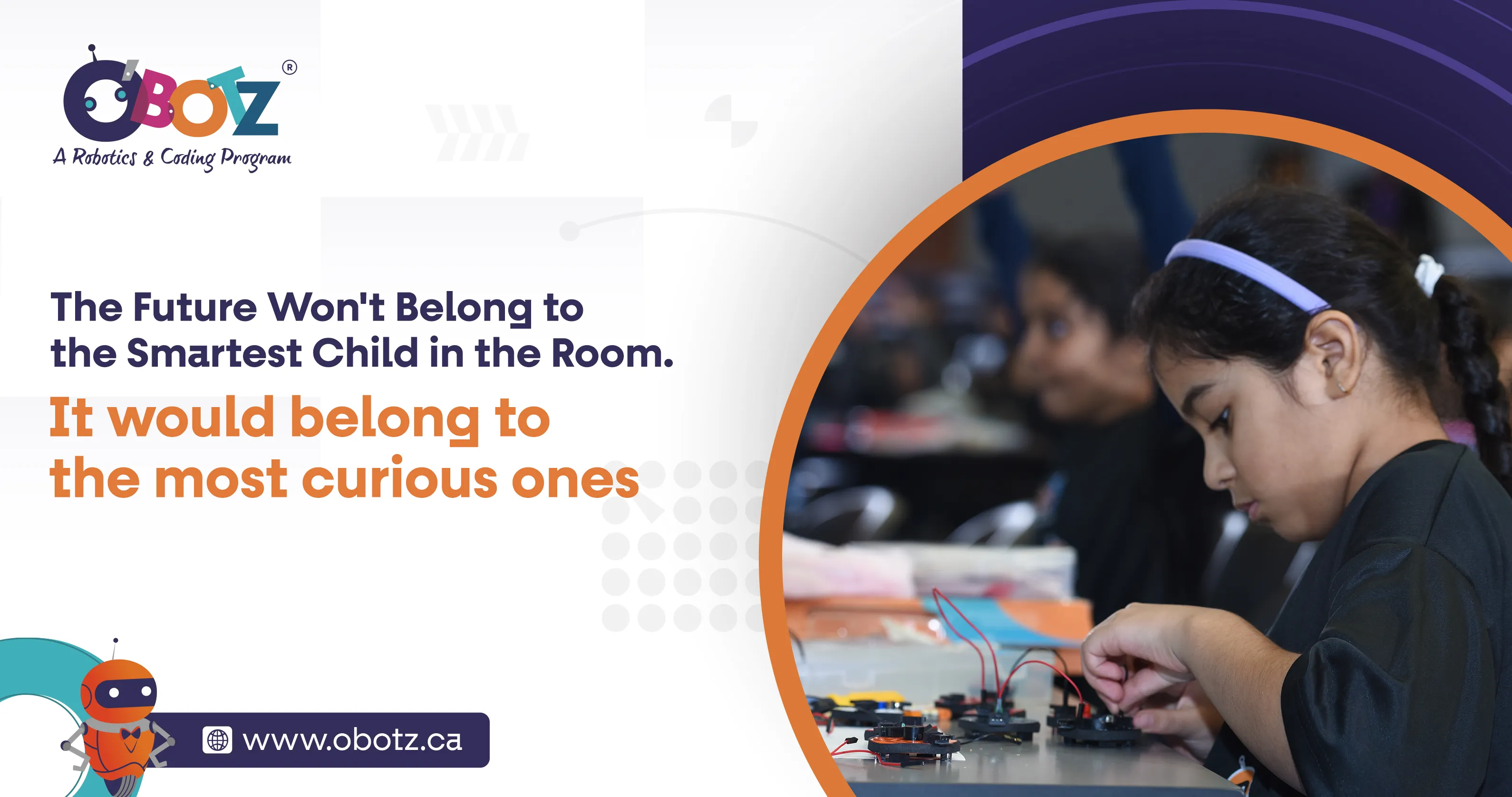
At OBotz, we believe the future belongs to curious minds. Through hands-on STEM education, children learn to investigate, experiment, build, and think independently.
Artificial Intelligence can answer factual questions in seconds.
Search engines can retrieve almost any piece of information instantly.
What technology cannot replace is curiosity.
Curious children naturally:
These are the same qualities employers increasingly value across technology careers.
A child who constantly asks "What happens if I change this?" often learns faster than someone who simply memorizes instructions.
Technology isn't about following instructions.
It's about solving problems that don't have obvious answers.
Imagine two students building the same robot.
The first follows every instruction perfectly.
The second finishes early and starts wondering:
The second child develops innovation.
Curiosity transforms projects into discoveries.
This is exactly why modern robotics classes for kids focus on exploration instead of simply completing assignments.
Many children fear making mistakes because school often rewards getting the right answer.
Technology works differently.
Every programmer encounters errors.
Every engineer experiences failed prototypes.
Every robotic design goes through multiple revisions.
Failure isn't the opposite of learning.
It's part of learning.
Children involved in robotics for kids gradually become comfortable experimenting because every mistake becomes another opportunity to improve.
Over time, they develop resilience alongside technical skills.
Many parents imagine coding as typing complex lines of code.
In reality, coding begins with curiosity.
Children constantly ask questions like:
Each question pushes them toward deeper understanding.
That's why families searching for coding classes for kids near me should look beyond programming languages.
The best programs inspire children to investigate, create, and discover—not simply memorize syntax.
Reading about robotics is interesting.
Building one is unforgettable.
When children physically assemble robots, sensors, motors, and circuits, they immediately see how ideas become reality.
Creative project-based learning also explains why our article on Proven Tips to Instill Curiosity in Teenagers highlights exploration as the foundation of lifelong learning.
Similarly, children discover limitless possibilities after reading about How Kids Can Turn Recycled Materials into Robots, where everyday household items become exciting engineering projects.
These experiences encourage children to keep asking:
"What else can I build?"
School schedules often leave little time for experimentation.
A dedicated STEM Camp changes that.
Instead of rushing through lessons, children:
This freedom encourages deeper thinking.
Children stop worrying about getting perfect answers and start enjoying the learning process itself.
Parents searching for exciting coding camps for kids often discover that project-based camps dramatically improve confidence, teamwork, and independent thinking.
OBotz also offers engaging STEM summer camp experiences designed to keep curiosity alive throughout school breaks.
Technology is evolving faster than ever.
Many jobs children will hold ten years from now don't even exist today.
The ability to learn continuously will become more valuable than any single technical skill.
Our article on the Future of Robotics and Coding Education 2026 explains how adaptability, creativity, and curiosity are shaping tomorrow's workforce.
Children who remain curious won't fear new technology.
They'll build it.
Parents often search online for the best coding classes near me, hoping to give their children a competitive advantage.
The better question might be:
"Which program keeps my child excited to learn?"
An outstanding STEM program doesn't simply teach coding.
It encourages children to:
These abilities stay with children long after they finish a project.
Families across Canada are increasingly exploring opportunities like coding classes for kids Surrey, coding classes Durham, and coding classes for kids Ottawa, while many also search for coding camps near me or kids camps near me that combine fun with meaningful learning.
No one knows exactly what technology will look like in 2035.
But one thing is becoming increasingly clear.
The children who succeed won't necessarily be those with the highest IQ.
They'll be the ones who never stop exploring.
Every question they ask today becomes a solution they create tomorrow.
At OBotz, we believe curiosity is the starting point for innovation. Through engaging robotics, coding, and STEM experiences, children develop the confidence to solve problems, create technology, and shape the future. Learn more about our programs on our website, or request a free trial class and see how it ignites your child's curiosity.
Curiosity motivates children to ask questions, experiment, and learn from mistakes, which leads to deeper understanding. Intelligence may help solve problems quickly, but curiosity keeps children learning long after the lesson ends.
Robotics projects encourage children to design, test, improve, and solve challenges independently. This hands-on process naturally develops creative thinking while making learning enjoyable and meaningful.
Skills such as curiosity, creativity, resilience, communication, collaboration, and problem-solving are increasingly valued in STEM careers. These qualities help children adapt to rapidly changing technologies throughout their lives.
Parents can encourage exploration by asking open-ended questions, celebrating experimentation, and allowing children to solve problems independently. Providing opportunities for hands-on STEM activities also keeps natural curiosity alive.
The best robotics and coding programs combine technical learning with creativity, teamwork, and real-world problem-solving. Children build projects, explore new ideas, and gain confidence rather than simply following instructions.
Hands-on STEM camps immerse children in exciting projects that encourage exploration, experimentation, and innovation. By learning through building and creating, children become more confident, inquisitive, and eager to tackle new challenges.