How Canadian Schools' Report Cards Are Missing the Most Important Skill of 2026

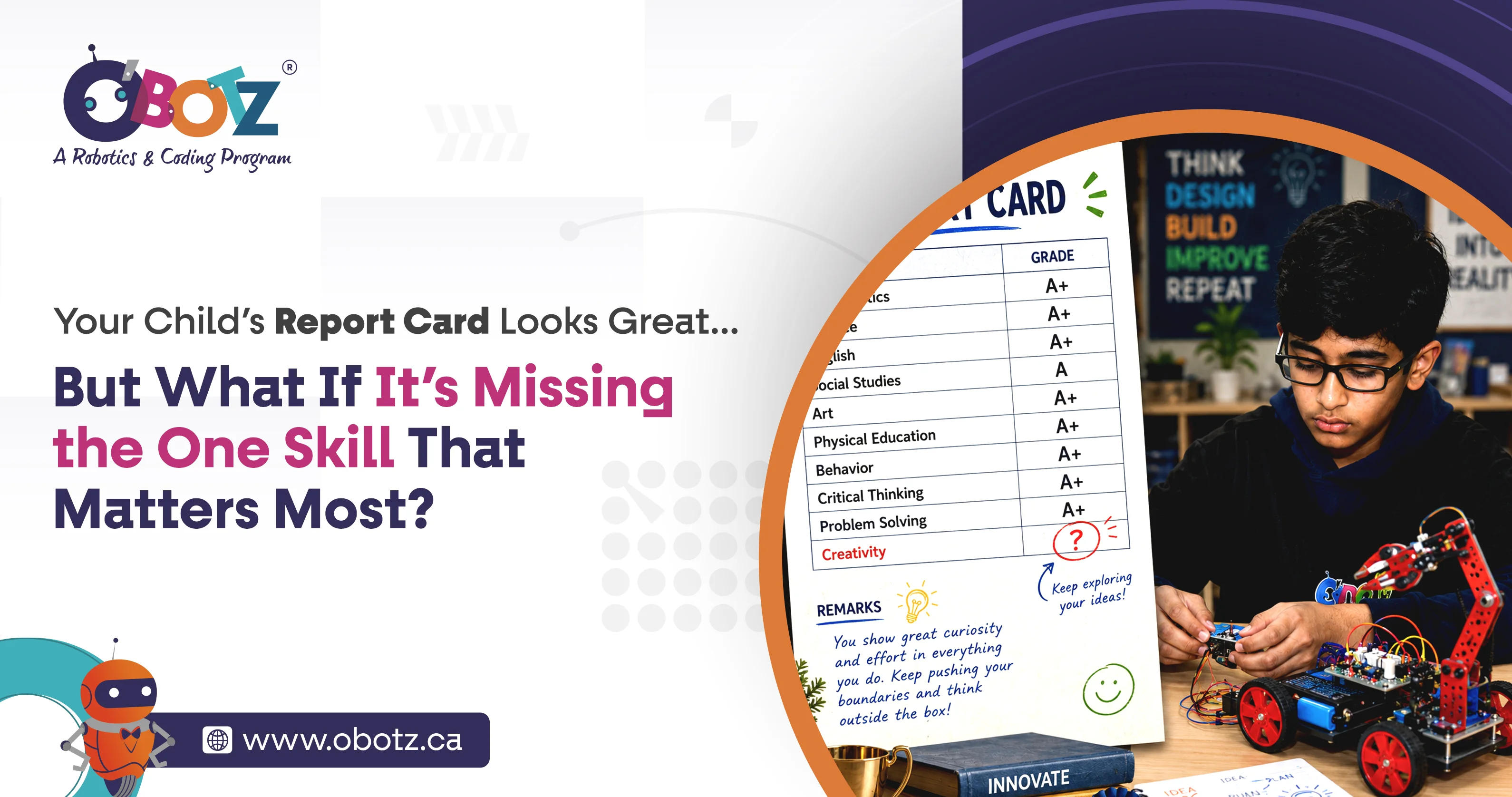
Parents across Canada still wait for the same thing every school term: report cards. Grades in math, science, English, attendance, participation - everything neatly organized into measurable categories.
But in 2026, many educators and parents are beginning to ask a deeper question:
What if the most important skill for the future isn’t even being measured?
Traditional education systems were designed for an industrial-age world where memorization, repetition, and standardized testing mattered most. But the future of work now values adaptability, problem-solving, creativity, collaboration, and innovation far more than rote learning alone.

And that’s exactly where many believe Canadian schools report cards missing important skills has become a growing concern.
Across the country, parents are increasingly exploring programs like robotics and coding classes for kids to help bridge this gap. Platforms like OBotz are becoming popular because they focus on the real-world abilities children will actually need in the coming decade.
Most report cards still focus heavily on academic performance. While academic foundations matter, they often fail to evaluate how children think, adapt, collaborate, or solve unfamiliar problems.
A child may score well in exams but struggle with independent thinking. Another child may be highly creative and solution-oriented yet receive average grades because traditional evaluation systems don’t fully capture those strengths.
This is where the discussion around skills not measured in school report cards becomes incredibly important.
Today’s employers increasingly value people who can:
Yet most of these abilities are difficult to measure using standard classroom grading systems.
If experts across industries agree on one thing, it’s this: adaptability and problem-solving will define future success.
Artificial intelligence, automation, and rapidly evolving technology are changing careers faster than educational systems can update curriculums. Children entering primary school today may eventually work in jobs that don’t even exist yet.
That’s why future-ready skills for kids are becoming a major focus for forward-thinking parents across Canada.
The ability to analyze situations, experiment, fail safely, and improve through iteration matters more than simply reproducing textbook answers. These are the exact kinds of experiences children gain through hands-on STEM learning environments.
Programs that combine technology, experimentation, and creativity help children develop confidence in uncertainty, something traditional academics often struggle to teach.
Parents are no longer viewing STEM programs as “extra activities.” Increasingly, they are seen as essential future preparation.
Modern STEM education Canada initiatives focus not just on science or coding itself, but on the thinking process behind innovation.
When children build robots, debug code, or solve engineering challenges, they learn how to:
These are transferable life skills — not just technical abilities.
Parents looking to better understand these benefits can Explore STEM Learning for Kids.
One of the biggest concerns educators now discuss is the decline in independent thinking among students.
Children are often taught how to arrive at the “correct answer,” but not necessarily how to evaluate multiple solutions or think critically about problems.
This is why critical thinking skills for children are becoming one of the most valuable developmental areas today.
Critical thinking helps children:
Ironically, many schools acknowledge the importance of critical thinking, yet report cards still struggle to measure it effectively.
Hands-on robotics and coding environments naturally encourage this skill because there’s rarely just one correct path to solving a challenge.
Many parents initially assume coding classes are only for children interested in technology careers. But the real value goes much deeper.
Modern coding and robotics programs for kids teach resilience, experimentation, and confidence, which makes STEM learning a pathway to future skills for kids.
When children work on robotics projects, things rarely function perfectly on the first attempt. They troubleshoot, rethink strategies, and learn persistence naturally through the process.
That’s why robotics and coding classes for kids are increasingly viewed as cognitive development programs — not just technical training.
At OBotz STEM Programs, children are exposed to structured STEM activities that combine learning with creativity and problem-solving in an engaging environment.
Another issue traditional report cards rarely capture is confidence under pressure.
Some children excel academically but hesitate when faced with unfamiliar challenges. Others may not score highest in tests yet show exceptional initiative, curiosity, and leadership during collaborative activities.
These behavioural and cognitive traits matter enormously in the real world.
Children who participate in STEM and robotics environments often become more comfortable:
These experiences help build emotional resilience alongside technical ability.
And in a rapidly changing future, resilience may matter just as much as intelligence.
Across provinces including Ontario, British Columbia, and Alberta, parents are increasingly investing in enrichment learning outside school hours.
Why?
Because many families recognize that academic success alone may no longer guarantee future readiness.
They want children to become:
That’s why after-school STEM learning is growing rapidly across Canada.
The goal is no longer simply “better grades.” It's a broader development.
And that shift may completely redefine how parents evaluate educational success over the next decade.
Imagine a future report card measuring:
That future may arrive sooner than we think.
But until educational systems evolve fully, many parents are choosing supplementary learning environments to help children develop these abilities today.
Programs focused on STEM, robotics, coding, and creative problem-solving are becoming less of an “advantage” and more of a necessity.
For many Canadian families, the goal is no longer just academic achievement. It’s preparing children for a future that rewards thinkers, creators, and innovators.
And that preparation often begins outside the traditional classroom.
If you want your child to build future-ready confidence, creativity, and problem-solving abilities alongside academics, explore OBotz and discover how hands-on STEM learning is shaping the next generation.
Give your child exposure to hands-on STEM learning, robotics, and coding experiences that go beyond traditional academics.
Book an OBotz Experience Now to understand how robotics and coding goes beyond traditional academics.
Traditional report cards mainly evaluate academic performance like test scores, assignments, and classroom participation. However, many future-focused abilities such as creativity, adaptability, leadership, and problem-solving are harder to measure using conventional grading systems.
Many experts believe adaptability and critical thinking will become the most valuable skills for future success. As technology and careers evolve rapidly, children who can solve problems, learn independently, and think creatively will have a major advantage.
Robotics and coding programs teach children persistence, logical thinking, teamwork, and confidence. Kids learn how to experiment, solve problems, handle mistakes, and improve through trial and error — skills that apply far beyond technology fields.
Canadian parents increasingly view STEM learning as preparation for future careers and life skills. These programs help children build confidence, innovation, communication, and independent thinking alongside academic growth.
Robotics programs help children develop collaboration, critical thinking, creativity, resilience, and problem-solving abilities. They also improve communication skills and encourage children to become more comfortable with experimentation and innovation.